Fibrosis Assay
Fast, Reliable Fibrosis Quantification for Preclinical Research
When organ injuries occur, damaged tissue is gradually replaced by an excessive extra-cellular matrix deposition, resulting in fibrosis. This process alters the structure and function of the targeted organ leading to a loss function, and even the need for transplantation. Understanding tissue fibrosis is crucial for the development of new therapeutic approaches aimed at slowing or preventing its progression in the context of kidney diseases or related organs.
Fibrosis is a hallmark of disease progression across multiple organ systems, yet quantifying it accurately and efficiently remains a challenge in preclinical research. Our in vitro fibrosis assay addresses this gap by delivering rapid, reproducible fibrosis detection across a broad range of tissue types enabling researchers to generate high-quality data without sacrificing throughput.
Contact us to learn more about how we can support your project with our in vitro fibrosis assay.
Assay parameters
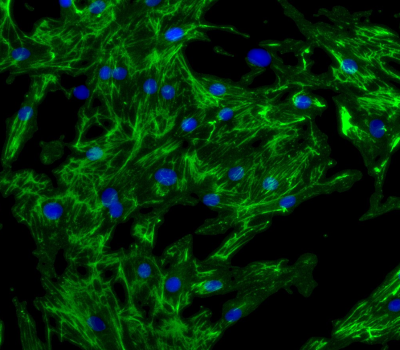
| Parameter | Details |
|---|---|
| Cell type | Human primary fibroblasts or epithelial cells |
| Cell origin | Renal, Lung, Cardiac, Skin, Liver |
| Donor variability | Multi-donor availability |
| Format | 96-well plate |
| Image acquisition | Automated - 7 to 25 images per well |
| Fibrosis markers | Fibronectin, intracellular α-SMA fibers |
| Quantification method | Fiber-search algorithm (Fibroblast-to-Myofibroblast transition) |
| Secreted proteins | Extracellular matrix proteins & cytokines by ELISA |
| Turnaround | Fast - optimized for high throughput |
Study design

Assay readouts
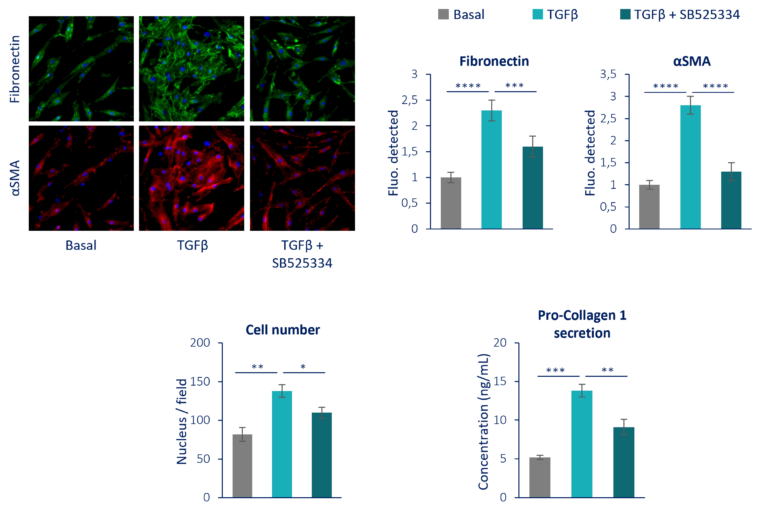
| Parameters | Details |
|---|---|
| Fibronectin expression | Extracellular matrix marker of active fibrotic remodeling |
| α-SMA fiber quantification | Automated detection of intracellular stress fibers via fiber-search algorithm, a hallmark of Fibroblast-to-Myofibroblast Transition (FMT) |
| Secreted ECM proteins & cytokines | Quantified by ELISA for soluble fibrosis mediators |
| Automated image analysis | 7 images per well across a full 96-well plate for statistically robust results |
Frequently Asked Questions – Fibrosis Assay
The Fibrosis Assay supports fibrosis detection across liver, lung, kidney, skin and cardiac tissue. It is also applicable to multi-organ and systemic fibrosis research models.
Yes., the Fibrosis Assay is designed for preclinical research applications and is compatible with standard rodent fibrosis models including UUO, bleomycin, and NASH/NAFLD models.
Yes, the Fibrosis Assay is designed to complement NEPHRIX Biosolutions broader portfolio of preclinical kidney and fibrosis research tools, enabling comprehensive multi-endpoint studies within a single experimental framework.