UNx/STZ Model – Diabetic Kidney Disease and Renal Fibrosis
Evaluate kidney targeted therapies beyond hyperglycemia
Selecting a model for Diabetic Kidney Disease (DKD) requires more than establishing diabetes. For candidates targeting renal injury, the study needs measurable kidney endpoints that address the therapeutic hypothesis. The UNx/STZ model combines unilateral nephrectomy with streptozotocin (STZ) induced diabetes. STZ establishes an insulin-deficient diabetic environment, while UNx reduces nephron mass and increases the workload placed on the remaining kidney.
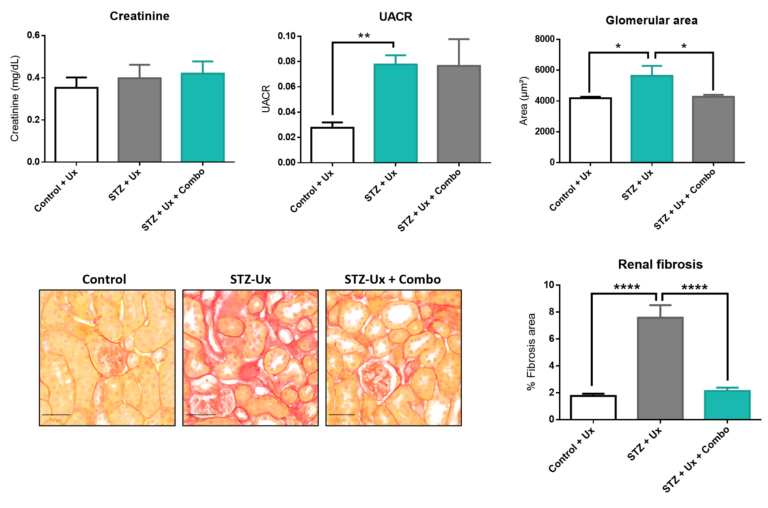
At NEPHRIX Biosolutions, our multiple-dose STZ + UNx model develops robust albuminuria and a pronounced renal fibrotic response. These features make it particularly relevant when evaluating compounds intended to limit kidney injury or fibrotic remodeling in a diabetic setting.
Why Choose Our Why UNx/STZ for Diabetic Kidney Disease research?
- A stronger renal phenotype: Combining multiple-dose STZ with unilateral nephrectomy adds renal stress to the diabetic environment, enhancing kidney disease features beyond hyperglycemia alone.
- Relevant endpoints for kidney-targeted therapies: Robust albuminuria and amplified renal fibrosis support studies focused on renal injury and fibrotic remodeling.
- A relevant setting for antifibrotic research: The pronounced fibrotic response makes this model particularly useful when renal fibrosis is central to the candidate’s mechanism of action.
- Study planning guided by your therapeutic hypothesis: Our scientific team helps define the treatment window and endpoint strategy best aligned with your development objectives.
Download the poster of our UNx/STZ Model
Discuss your project with our experts!
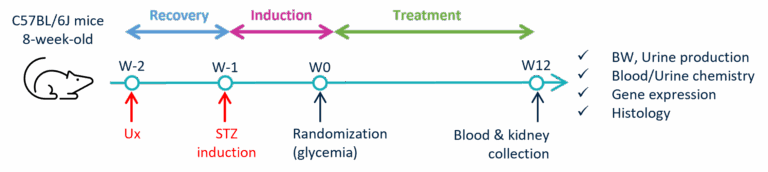
Study design UNx/STZ Model
Model readouts
Our UNx/STZ model brings together multiple complementary renal readouts including urinary albumin and tissue fibrosis.
| Category | Readout / Marker | Methods |
|---|---|---|
| Metabolic monitoring | Blood glucose / hyperglycemia monitoring | Blood glucose measurement |
| Glucose tolerance test (GTT) | Serial blood glucose measurements following glucose administration | |
| Insulin tolerance test (ITT) | Serial blood glucose measurements following insulin administration | |
| Body weight | Longitudinal body weight assessement | |
| Histopathology | Interstitial fibrosis quantification | Picro Sirius Red staining |
| Collagen deposition | Masson’s Trichrome staining | |
| Tubular atrophy / injury | H&E staining | |
| Glomerular injury / mesangial expansion | PAS staining and histological assessment | |
| Fibrosis markers | α-SMA (myofibroblast activation) | IHC / Western blot / qPCR |
| TGF-β1 expression | Gene expression (qPCR) / Dosage (ELISA) | |
| Fibronectin | IHC / Gene expression (qPCR) | |
| Inflammatory | Inflammatory cell infiltration | IHC (F4/80, NFkB) |
| Albuminuria | Urinary albumin-to-creatinine ratio (UACR) | Urinary albumin and creatinine measurements; ratio calculation |
Frequently Asked Questions - UNx/STZ
The STZ model uses streptozotocin to induce diabetes. The UNx/STZ model adds unilateral nephrectomy, reducing nephron mass and increasing the workload placed on the remaining kidney. Published research comparing STZ alone with STZ plus unilateral nephrectomy in C57BL/6J mice reported greater glomerular and tubular injury with the combined model, including mesangial expansion and tubulointerstitial fibrosis. These findings support the rationale for adding renal stress when STZ alone produces insufficient kidney injury for the research question. The precise phenotype remains dependent on the experimental protocol, animal background and study duration.
An antifibrotic study requires a measurable fibrotic response. The amplified renal fibrosis described in the NEPHRIX Biosolutions UNx/STZ model provides a rationale for considering this model when fibrosis is central to the therapeutic hypothesis.
In the study design illustrated above, the treatment and follow-up period runs for 12 weeks. The overall schedule may vary depending on the therapeutic objective, treatment initiation and planned assessments.
Contact our scientific team to define a timeline aligned with your candidate’s mechanism of action and study objectives.
The three models answer different questions. UUO produces rapid, robust tubulointerstitial fibrosis through surgical obstruction, within days to a couple of weeks, but it is not a metabolic or diabetic disease setting. The adenine diet induces tubular injury and fibrosis through crystal-driven nephropathy, with no diabetic component. The UNx/STZ model builds fibrosis on a diabetic background with albuminuria, which makes it better suited when the candidate targets diabetic kidney disease and a longer treatment window is needed.
Related models